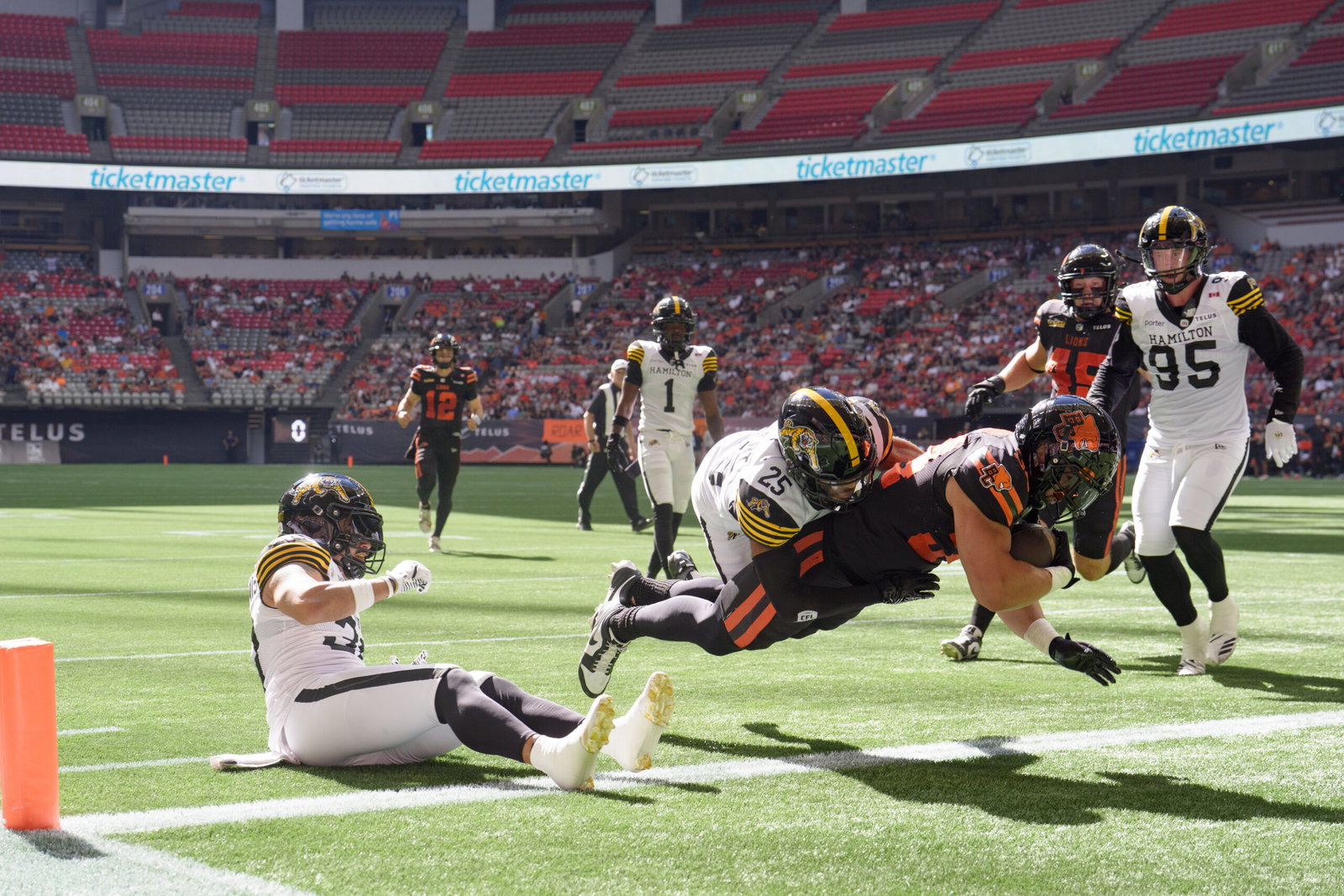
The Hamilton Tiger-Cats fell to 3-6 on the season with a 27-24 loss in Vancouver to the B.C. Lions on Saturday night. Harrison Frost showed moments in his first career CFL start, but it was not enough to move the needle.
A three-point game that comes down to the wire is generally what fans want to see in this league. However, this was not a battle-it-out, good football, back-and-forth affair. It felt like through most of the game, both teams were trying to lose.
There was good, and there was improvement in certain areas from units that had been on a downward trajectory as of late. Unfortunately, it is the same result for Hamilton as it has been since Bo Levi Mitchell’s injury.
What are the takeaways from this loss to the Lions?
MAKING THE MOST OF THEIR CHANCES
There were two key field position misses by the Tiger-Cats offence that stood out to me in the moment and, now with the result, loom even larger.
The first was the opening kickoff. The Lions kicked to the Tiger-Cats to begin the game and, unsurprisingly, wanted nothing to do with Isaiah Wooden. Instead of a traditional deep kick, the Lions squibbed the ball to the second level of the Ticats’ return team.
Owen Hubert scooped up the rolling ball and elected to return it. Aside from holding the ball in his upfield (right) arm, it was a strong return. This set the Ticats to scrimmage their first offensive drive of the game from their own 52-yard line.
After a three-yard completion on first down, an almost intercepted ball on second down forced a punt from the Tiger-Cats.
The issue? Not being able to capitalize on field position. Even a field goal could have changed the tone on how the Ticats started offensively in this game. Alas, they were forced to give up the ball and put it in the hands of Nathan Rourke and the B.C. offence.
Normally, punting from midfield comes with its advantages. Like Hamilton’s offence, if the Lions come out of the gate slow, you position yourself to be a play away from scoring range if you win the early field-position battle.
However, you need to remember the team you are talking about. Last week, I told you that the Tiger-Cats defence had allowed points on their opponents’ opening drive in six of the first eight games of the season. On Saturday night, that went to seven of the first nine games.
An early advantage turned into a detriment for the Tiger-Cats. Is it the lack of experience, the quality of the script, or simply the execution? It could be all three. Regardless, if you are given an opportunity to start with a bang, you need to take it. This was the first instance Hamilton did not.
The second came late in the third quarter. It was the first of three drives in the final twenty minutes where it felt as though the Lions were going to put the game away. B.C. lined up for a 42-yard field goal, and it was blocked by Mario Kendricks at the line of scrimmage. Philip Ossai would recover and return it to the 55-yard line. Instead of trailing by seven, Hamilton was down by four with great field position.
The play calling on the ensuing drive by the Tiger-Cats was good; the execution was not. To that point in the second half, Harrison Frost was one-of-five for six yards, and the Tiger-Cats had yet to record a first down.
When there is a sudden change of possession, the idea is to take a deep shot. This is more evident when you are in plus territory. With Hamilton running their first play from midfield, this was the ideal place to call for a deep throw.
Kenny Lawler was the intended receiver; however, he was double covered. Frost was hyper-focused on Lawler and threw it anyway. Luckily for Hamilton, the ball landed a few yards away from harm and resulted in a second-and-10.
The next play, Frost was hyper-focused on Kurleigh Gittens Jr. on an intermediate hook route to his right. There was no other receiver that Frost looked at.
Darnell Sankey read the play easily and undercut the route. He got his hands on the ball, sending it high in the air behind him. It landed in the arms of nickel defender Deontai Williams. Eventually, off the turnover, the Lions would go down and kick a field goal, giving them the seven-point lead that had been taken away moments before.
On two separate occasions in the game, the Tiger-Cats started 58 yards away or closer to the end zone, and those drives resulted in them being outscored 10-0 by the Lions. While I applaud Hamilton for scoring a touchdown following Jamal Peters’ interception in the fourth quarter, they were already playing catch-up.
Even if you are on your fourth starting quarterback of the season, these are situations and opportunities you need to convert on. We have plenty of examples of what happens when you do not.
FROSTED OFFENCE WARMING
This was arguably the best we have seen the Ticats offence operate since the need for a rotating cast of quarterbacks. The only comparable would be the Tre Ford start against the Argonauts in Week 7.
Frost had a slow start to each half. The first two drives of the opening half resulted in a two-and-out, and as mentioned before, there were no first downs in the third quarter. But once he gathered his footing, he was fine. This was not a great performance by any stretch, but it was better than what we have seen from Hamilton in the past six weeks.
While Frost looked down receivers at points, he does process decisions (even the wrong ones) at a faster clip than Dolegala or Ford. While the offensive line overall improved from last week’s disaster against Calgary, there were still moments of blown blocking schemes. Frost was able to stand in tight and get the ball out, regardless of the pressure. He was smart enough to throw the ball away when the pressure started to collapse on him.
Frost also had his fair share of miscues. There was a chance to convert a second down to Kurleigh Gittens Jr. over the middle where the ball was thrown high and behind the receiver. That was late in the fourth quarter, right after the Ticats tied the game. The accuracy was not fantastic, but he made enough throws in spots to move the ball.
Hamilton still needs more from the quarterback position; however, Frost showed enough for fans to be cautiously optimistic about his growth. That cautious optimism will be put to the ultimate test in Week 11 when the Ticats host the West Division-leading Saskatchewan Roughriders.
While the quarterback play improved, the running game was once again non-existent. Larry Rountree III was limited to three carries for 13 yards, which was a team high. That is not “we tried it, and it is not working” — that is not trying at all.
The first carry was on Hamilton’s third offensive play of the game. On Rountree’s first two carries, it looked like it was something the team could commit to. All 13 of his rushing yards came on those two attempts. The third carry was the problem, with two offensive linemen chasing defenders into the backfield. That was with 3:46 to go in the first half. They never ran it again.
Whether it is a lack of commitment or a belief that the team simply cannot run the football, this is a problem. If you want to make a struggling quarterback room look even worse, put everything on their shoulders. Canadian football is a beast in the fact that you only get three downs, and it forces you to throw. A team that cannot run and is inconsistent at best throwing the football will not go very far.
SPECIAL TEAMS SHOWS UP
If anyone you know left that game with the belief that Hamilton lost because of a missed 57-yard field goal to tie it at the end, you have my approval to stop listening to their opinions. Marc Liegghio, who has been arguably the most consistent player for the Ticats this season, was put in a tough spot. His career-long field goal still stands at 55 yards. He had the leg for it; it just did not land between the uprights.
Just as much blame sits on the offence and the defence for that field goal attempt being that long. If you are leaving a game up to a 57-yard field goal to get to overtime, your odds of winning are slim.
While the missed attempt leaves a sour taste, the special teams were the best unit on the field for Hamilton. The coverage was excellent, limiting Lions returns. The return game was great, creating good starting field position. I had noticed in the last five weeks that the special teams coverage had begun to sink. More returns were breaking for chunk yardage, and too many tackles were being missed. This flipped to what the expectation was of that unit from the start of the year.
There was enough good from the third group that it leaves an encouraging feeling moving forward. Hopefully, it is something the Tiger-Cats can build off in the back half of the regular season.
MUCH TO BE DESIRED
The Hamilton defence leaves me scratching my head almost every week. Week 10 in Vancouver almost perfectly encapsulates what we have seen from them all season.
Another week, another first drive score from the opponents. Whether you have a veteran Grey Cup-winner or a first-time starter under centre, that simply is not good enough. Why can’t the Ticats defence show up on time, week in and week out?
The lack of organic pass rush is an issue. Over the course of the game, the defensive line is not forcing the opposing quarterbacks to make bad throws. You do not need to get hits on the quarterback; you simply need them to feel your presence. Getting close, a hand in the lane, or just letting him know you are there can make a difference. This does not happen regularly for the Tiger-Cats.
Then there is the biggest issue, which I have talked about since the beginning of the season. This unit struggles on second-and-long. The inability to force a punt or a field goal after a win on first down is astonishing.
Sometimes it is self-inflicted, as we saw on the opening drive of the game. B.C. had a second-and-six, and Hamilton took Nathan Rourke down behind the line of scrimmage. Yet two Ticats jumped offside, which allowed a second-and-one to be converted by Zander Horvath. The Lions would go down and score a touchdown on that drive.
Twice on the final B.C. drive of the game, the Lions were forced into second-and-long. The first, had the Tiger-Cats gotten a stop, would have forced a punt. Instead, Rourke found Justin McInnis for 33 yards and a first down at the Hamilton 36-yard line with 1:55 remaining on the clock. This was the first time McInnis had been targeted by Rourke since a drop earlier in the fourth quarter.
On the following play, Rourke rolled to his right. Destin Talbert knocked down a pass and forced the Lions into second-and-long. A field goal from there would have been 43 yards and left approximately 1:18 on the clock for the offence.
Hamilton’s defence could not get off the field again. Rourke completed a screen pass to Jevon Cottoy, who broke tackles and pushed his way for an 11-yard gain, moving the sticks.
The Lions were able to work the clock down to 28 seconds before kicking a field goal. This limited what the Hamilton offence could run to try and equalize the game at the end.
These were not the only issues defensively for Hamilton. More dropped potential turnovers loomed large. Jamal Peters did get an interception that went through the hands of Keon Hatcher. Yet, there were more misses than conversions in that regard.
Despite a 370-yard performance by Rourke, he was far from impressive on the night. Missed throws and receivers dropping easy passes. An ugly performance from the Lions still did not allow the Tiger-Cats to get a victory.
There was a drive in the first half where the ball went in and out of the hands of Zamari Walton. On second-and-10, Robert Panabaker intercepted Rourke, but Hamilton’s defence was offside. Sound familiar? Luckily for the Ticats, B.C. was forced to punt.
Hamilton’s defence is okay by CFL standards. They are not a juggernaut, but they are not terrible. Their mistakes do snowball into bigger issues, though.
The problem is the offence is not good enough for the defence to be average. For the Tiger-Cats to win, the defence needs takeaways and potentially even scores. The chances are there, yet they do not materialize. The offence does not help, going two-and-out at least seven times in the game. That leaves your defence on the field too much.
Simply put, for the Tiger-Cats to find victories, everyone needs to be better. The unit you look to is the defence because you know they can perform better. They will need to be at their best next Saturday against the Roughriders.
UP NEXT
The Tiger-Cats have three games before their Labour Day clash with the Toronto Argonauts on September 7. Those three games are home to Saskatchewan, at Toronto, and at Calgary. Following the Labour Day matchup, the Tiger-Cats will have their first bye since Week 4.
The outlook on the season can change between now and then for the Ticats. As I mentioned, the Tiger-Cats have played half their season schedule so far. To finish with a .500 record, Hamilton will need to go 6-3 to finish the regular season. A tough task, yet not impossible.
The Ticats will need to take it one game at a time and build off playing good football. That will start on Saturday, August 15 at 7:00 p.m. EDT when they host the Saskatchewan Roughriders at Hamilton Stadium.


From 3DownNation Experts






Calgary Stampeders
Calgary Stampeders release opening-day starter Shaun Peterson Jr.

Calgary Stampeders
Former Calgary Stampeders running back Rick Galbos dead at 75
Saskatchewan Roughriders
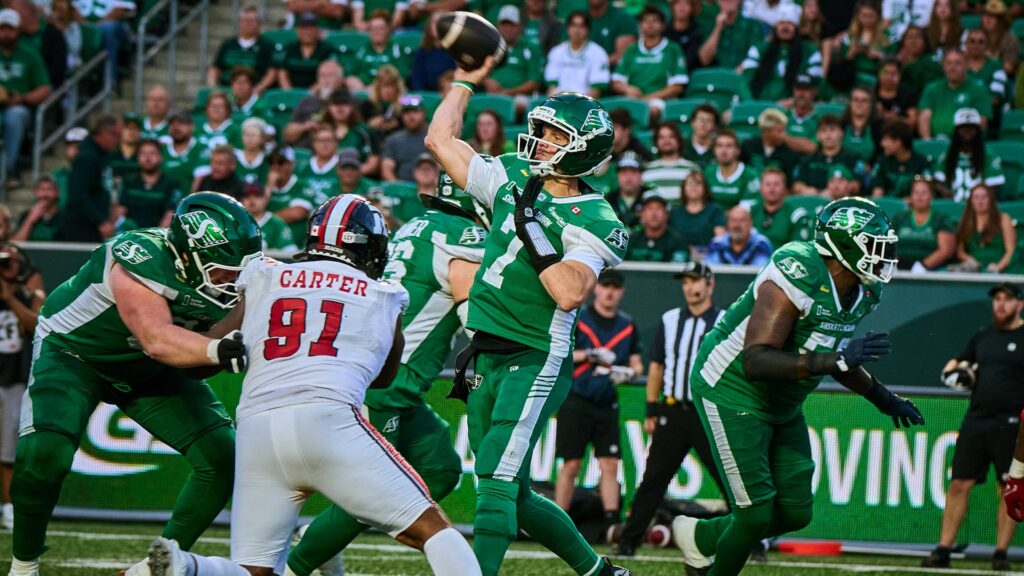
Corey Mace wouldn’t let Trevor Harris ‘brush off’ 40,000 career passing yards milestone
Saskatchewan Roughriders
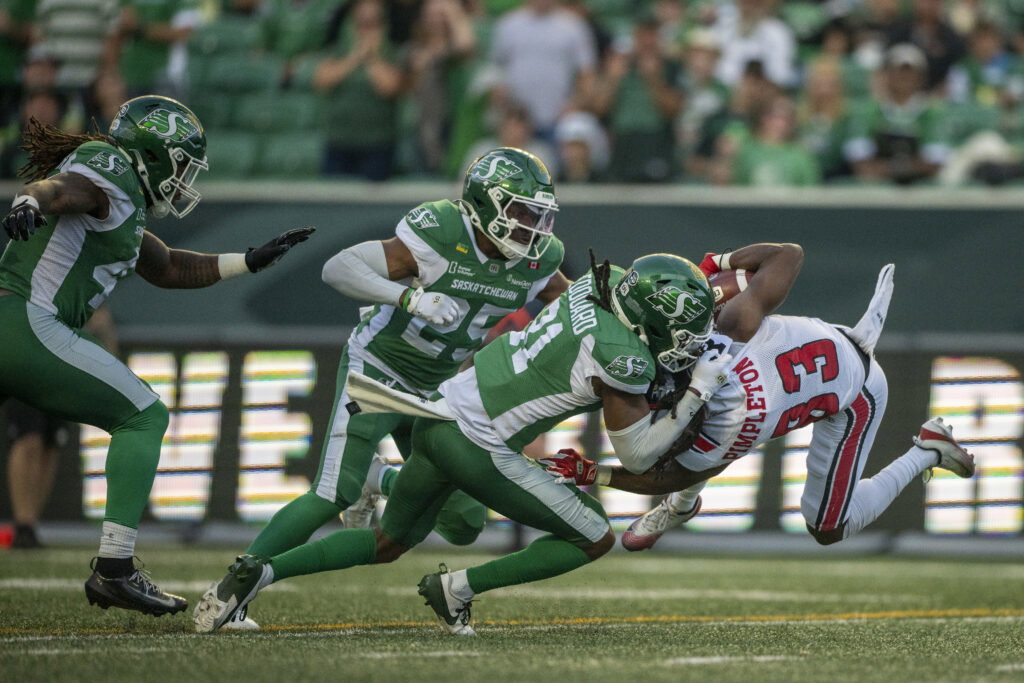
Saskatchewan Roughriders chop Redblacks with second-half buzzsaw (& other thoughts)

Winnipeg Blue Bombers
Zach Collaros returns to practice with Winnipeg Blue Bombers, takes first-team reps
Winnipeg Blue Bombers
Winnipeg Blue Bombers bring back Matt Jaworski following car accident


Toronto Argonauts
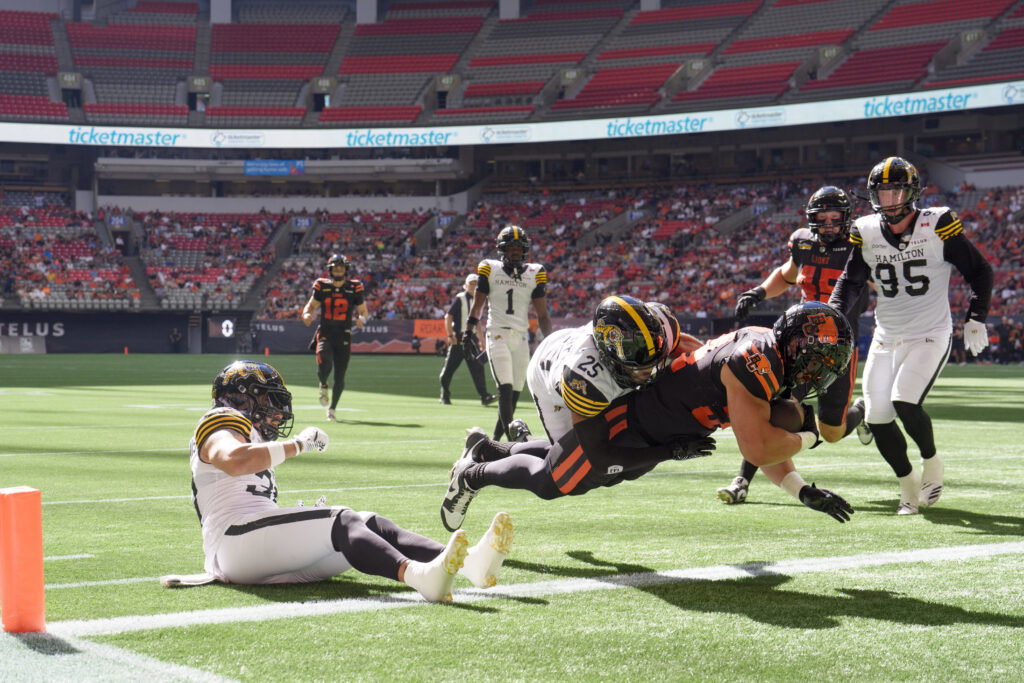
Toronto Argonauts bring back training-camp cut Akili Arnold, release one
Ottawa Redblacks
Ottawa Redblacks rolled by Riders in Regina (& 10 other thoughts)

Ottawa Redblacks
3DownNation CFL picks straight-up & against the spread: Week 10


Saskatchewan Roughriders
Saskatchewan Roughriders’ captain Jayden Dalke dies in car crash

Montreal Alouettes
Former CFL player Spencer Moore pleads guilty to intimate partner violence


Saskatchewan Roughriders
RCMP: Riders’ Jayden Dalke drove wrong way before fatal crash, had alcohol and cannabis in vehicle


Ottawa Redblacks
Ottawa Redblacks bring back Lewis Ward, add one other

Toronto Argonauts
Chad Kelly not expected to miss time for Toronto Argonauts: report