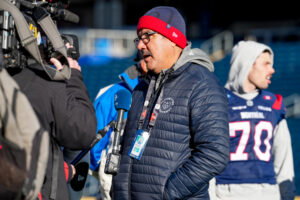
There was no corporate spin or pre-programmed talking points for season ticket holders when Saskatchewan Roughriders’ president and CEO Craig Reynolds addressed the Regina media on Thursday.
Instead, the man at the podium was a representative of a province in mourning, overcome with emotion at the passing of his predecessor, Jim Hopson.
“I’m just going to miss my friend,” Reynolds said, fighting back tears. “Just going to miss being able to talk to him and knowing I could reach out to him. He was always there. I’d pick and choose, but I just knew that he’d be there.”
Hopson, who passed away on Tuesday at the age of 73 after a long battle with colon cancer, was an indelible figure in Canada’s most football-crazy market. While his terminal diagnosis was understood by all in Rider Nation, his death still came as a blow to all who knew him or admired his work.
Reynolds had been grappling with how to quantify the legacy of his late mentor for weeks, as the team honoured Hopson in his final days. He rushed back from a family vacation in Arizona as soon as he heard the news, but the magnitude of the loss didn’t fully hit him until he arrived home.
“I tried to put (what he meant to the team) down in words, but it was difficult. He changed the course of this club forever,” Reynolds said. “No matter how many accolades we bestow upon him, it’s still not enough to thank him for what he did and the leadership he showed throughout his tenure here.”
A former offensive lineman for the team in the 1970s, Hopson was named the first-ever full-time president and CEO of the Roughriders in 2004. He would hold the role for a decade, ushering in the most prosperous era in club history. Under his leadership, the Riders posted record profits and became an internationally recognized brand, winning two Grey Cups in the process.
Reynolds arrived partway through that tenure, hired on as chief financial officer in 2009. The native of Foam Lake, Sask. was working in Alberta at the time and was lured home by the franchise’s compassionate and insightful leader.
“Right from the moment I met him, I thought this is somebody I want to work with and work for,” he recalled. “I just thought he was someone that I could learn a great deal from, someone I would enjoy coming to work with every single day. And I can honestly say that was the case. I loved every second I worked with Jim. He was an incredible mentor, I learned so much from him and I cherish every moment I spent with the man.”
While Reynolds would eventually take over the president’s role in 2014, he has always stood on the shoulders of his mentor. Once the laughingstock of the league, he took over a team with deep pockets, a rabid fan base, and a recent track record of success thanks to all that Hopson accomplished. That list also included a state-of-the-art new facility, Mosaic Stadium, which opened in 2017 after the Hall of Fame executive laid the groundwork.
“It was a total attitude change and he brought that attitude. I think it’s part and parcel with his positivity,” Reynolds explained. “He just sort of said, ‘Well, why can’t it be us? Why aren’t we the flagship franchise? Why can’t we be the flagship franchise? Why can’t we lead the league in every category?’ He just believed in that and had that positive attitude and inspired others to believe in that too.”
“He believed that the fans deserve this (stadium) and that we as a province deserve that and our football team deserved that and we deserved these incredible facilities that we have today. Even through that process, he entrusted me with so much around the stadium and I remember in the conversations he just kept saying, ‘Make it the best it can be.’ I just felt an incredible honour to be able to participate in that.”
Like all who worked for Hopson, Reynolds says he felt a sense of belief from his boss. Never overbearing, the late leader of the franchise treated everyone beneath him well and entrusted them to handle their aspects of the operation to the best of their own abilities. That inspired improved performance both on and off the field, with all aspects of the organization striving to win for Jim.
Even in his final years, Hopson remained dedicated to the Riders organization and was a regular presence on local radio. While his three-year fight with cancer forced him to step back, it never reduced his spirit.
“I think that’s just how Jim lived life, even after a tough loss,” Reynolds remarked. “I remember seeing Jim after the ’09 Grey Cup loss. I was near him and he was leaning up against the fence and really upset. And then I talked to him an hour later and he said, ‘We’ll be back.’ That was just how he was, he was just always positive.”
Although he will no longer be there as a sounding board for Reynolds, Hopson remains a part of the fabric of the Riders’ identity. After taking over a rinky-dink 12-man operation that relied on telethons to survive, he will be remembered as the man who built a modern business juggernaut with his vision and persistence.
“I don’t think he gets enough credit for that,” Reynolds marvelled. “Change is hard, period. Organizational change is very hard. And when you have 95 years of history to change, it’s especially hard. But he was the right person to do that. He was the right person at the right time and he was able to execute that brilliantly.”


B.C. Lions
The CFL’s highest-paid receivers in 2026
Edmonton Elks
The CFL’s highest-paid offensive linemen in 2026
Calgary Stampeders
Calgary Stampeders cut rookie Jeff Foreman
Calgary Stampeders
Veteran CFL receiver DaVaris Daniels retires from professional football
Saskatchewan Roughriders
Saskatchewan Roughriders sign Regina native Ryder Varga
Saskatchewan Roughriders
Saskatchewan Roughriders sign five from 2026 CFL Draft class
Winnipeg Blue Bombers
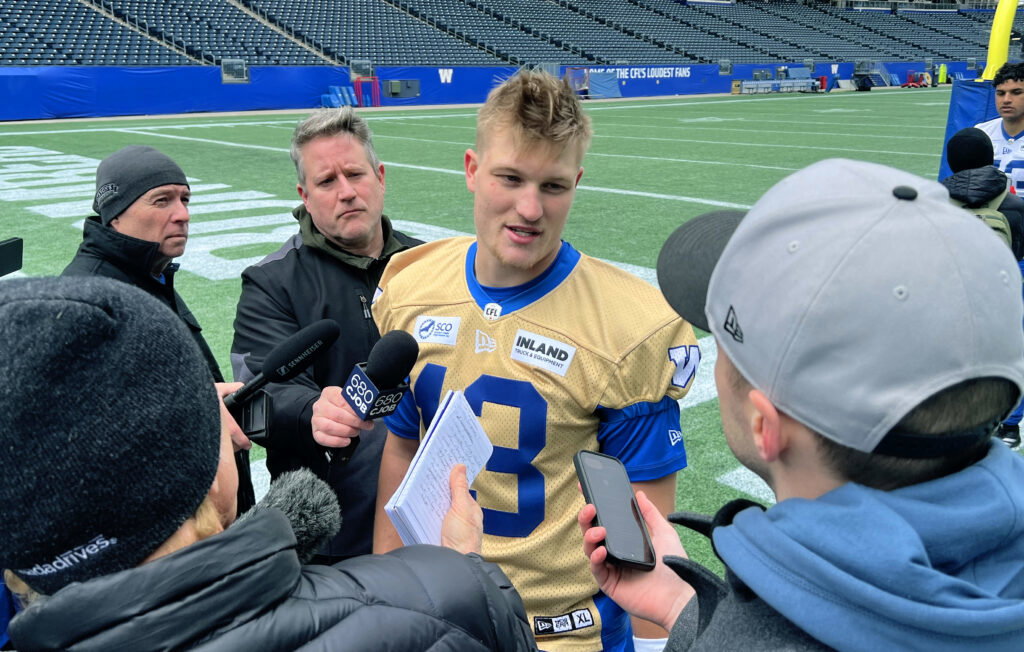
CFL rookie, training camp vet Taylor Elgersma ready to battle for Winnipeg Blue Bombers
Winnipeg Blue Bombers
The CFL’s highest-paid running backs and fullbacks in 2026
Hamilton Tiger-Cats
Hamilton Tiger-Cats sign former NFL player Gabe Jeudy-Lally, two others
Hamilton Tiger-Cats
Hamilton Tiger-Cats sign first-round CFL draft pick Jonathan Denis, seven others
Toronto Argonauts
Toronto Argonauts release Jon Edouard, one other
Toronto Argonauts
Toronto Argonauts unveil WWE, ‘loonie dog’ game themes for 2026
Ottawa Redblacks
Ottawa Redblacks 2026 CFL training camp primer (defence)
Ottawa Redblacks
Ottawa Redblacks 2026 CFL training camp primer (offence)
Montreal Alouettes
Montreal Alouettes sign CFL veteran Marco Dubois, four others
Montreal Alouettes
Montreal Alouettes release former first-round CFL draft pick Jesse Gibbon
B.C. Lions
John Hodge’s 2026 CFL Mock Draft 2.0
Winnipeg Blue Bombers
CFL star Brady Oliveira criticizes new playoff format
Calgary Stampeders
Minnesota Vikings waive All-CFL defensive lineman Jaylon Hutchings
Saskatchewan Roughriders
Plaza of Honour inductee Paul McCallum ‘never would have left Saskatchewan’ if not for one person
Ottawa Redblacks
Ottawa Redblacks fined for exceeding 2025 CFL salary cap
B.C. Lions
Analyzing every pick in the 2026 CFL Draft
From 3DownNation Reporters